BY JX HARVEST
BY JX HARVEST
Our bees & the Western Ghats
The native bees and the botanical library that give our honey its character.
Honey is a landscape you can taste. Ours is the Western Ghats — a 1,600-km mountain chain that runs down the spine of Kerala and ranks among the most biodiverse places on the planet. The bees here forage a botanical library no other region can offer, and each bloom leaves its signature in the jar.
Apis cerana indica
Smaller, gentler and hardier than the imported European bee, the native Indian hive bee nests in cavities, adapts beautifully to Kerala’s humidity and monsoon rhythm, and forages a wide sweep of flora. Its colonies are modest, so its honey is comparatively scarce — but it carries a delicacy high-yield industrial bees rarely match.
Tetragonula iridipennis
Barely 3–5 mm long and completely stingless, the cheruthen bee builds resin-and-wax nests and forages the tiniest, deepest flowers larger bees cannot reach. A whole colony yields only a few hundred grams a year — which is why cheruthen has always been treated as medicine, not sweetener. Keeping these bees is called meliponiculture.
The Queen’s Virgin Flight — the one flight of her life (1 min 17, with sound)
How a bee tells the others where to go
A colony of insects runs a working information system — and has done for millions of years.
The forage flight
A forager leaves the hive, finds a bloom, drinks nectar into a separate honey stomach, packs pollen onto her legs, and flies home. Our native Apis cerana works close to home — usually within a kilometre — which is one reason its honey tastes so specifically of the ground it was made on.
The Forage Flight — out to the bloom and home again (1 min 22, with sound)
The waggle dance
Back on the comb she dances a figure-of-eight. The angle of the straight run away from vertical is the angle of the flowers away from the sun; the length of the waggle tells the distance. Her sisters follow her and fly to a place they have never seen. Karl von Frisch won a Nobel Prize in 1973 for decoding it.
The Waggle Dance — how a bee gives directions in the dark (1 min 22, with sound)
We follow the bloom
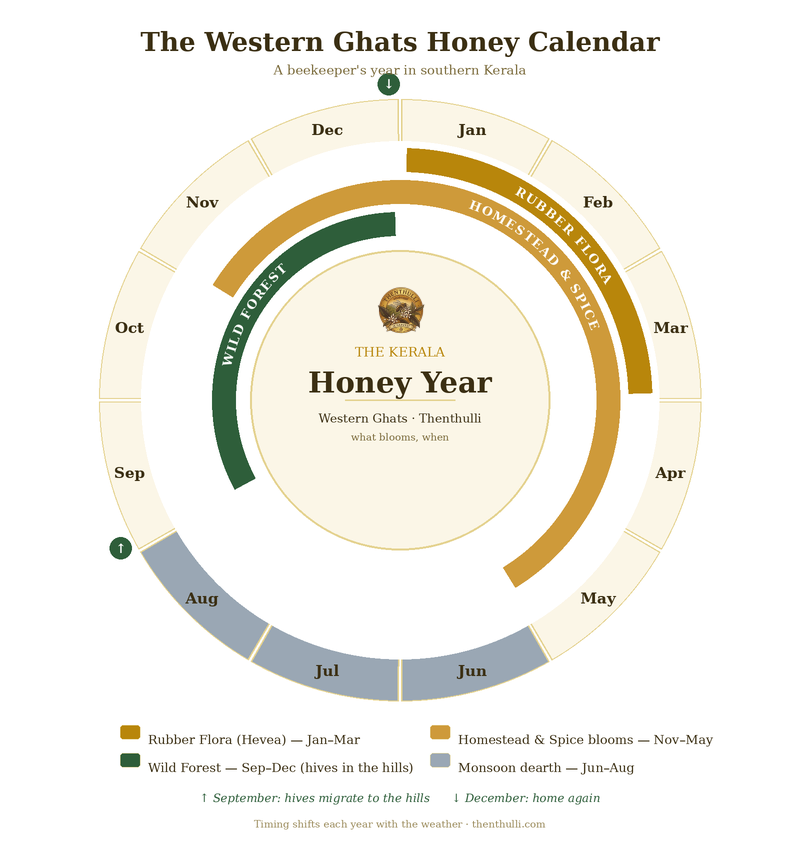
Most of the year our hives sit in the estates and homesteads around Trivandrum. But once the southwest monsoon eases and the high forests of the Western Ghats begin to flower, we migrate our colonies into the mountain ranges, place them where the wild flowering is richest, and keep them there through the post-monsoon bloom. In December, when the flow tapers, we bring them home. Hives are moved at night when the bees are inside and calm. It is the only honest way to gather genuine wild forest honey in any quantity — and it is why our Wild Forest Honey tastes of the high Ghats rather than of a garden.
What blooms, when
Our bees follow the blooms, and the blooms follow the seasons. After the monsoon we migrate our hives into the mountain ranges for the wild forest bloom, and bring them home in December.
Thenni’s Year — the honey year, bloom by bloom (2 min 22, with sound)
Where our honey comes from
Rubber estates (Hevea)
When rubber trees flush tender new leaves (roughly Jan–Mar), tiny extrafloral nectaries at the base of each young leaf weep a steady, sugar-rich nectar. The bees work it intensely for a few short weeks. The result is a very light, clean, mild honey — our Leaf Nectar Honey.
Wild forest & hill blooms
Beyond the estates lie the forests of the Agasthyamala and southern Western Ghats — wild trees, shrubs and climbers that bloom in waves after the rains. Honey gathered here is multifloral, darker, more aromatic — our Wild Forest Honey.
Homestead & spice blossoms
Coconut, coffee, cardamom, tamarind, moringa, tulsi and countless garden flowers feed the bees around Kerala’s homesteads through much of the year, adding their own quiet notes to the honey.