

Stand near a hive at ten on a warm night and it is almost silent. Where did everyone go? The same place you go: to sleep. Bees genuinely sleep — scientists have watched them do it since the 1980s, when careful observation of honeybees first showed all the signs we recognise from every sleeping animal: the body sinks, the head droops, the antennae — usually alert and always moving — fold down and go still. Wake a bee that has been kept up all night and she is clumsy the next day, sloppy in her waggle dances, slow to learn. Bees do not just rest. They need sleep, the way we do.
Where they sleep
It depends on the bee’s job. The young ones — the nurse bees who work deep inside the colony — nap in short snatches around the clock, often with their heads tucked into an empty cell, the way a tired worker dozes at her desk. The older foragers, who fly all day, keep hours more like ours: they work in daylight and sleep properly at night, settling towards the quiet edges of the nest, away from the busy centre — the colony’s version of a bedroom away from the kitchen. A forager may sleep five to eight hours in a night, mostly in the dark hours, motionless, antennae down.
And some bees sleep out. A forager caught far from home at dusk will not risk flying in the dark — she finds a flower, grips a petal or a stem with her jaws and legs, folds herself down and spends the night outside, dusted with dew, flying home at first light. Male bees and many solitary bees do this every single night. If you have ever found a bee sitting perfectly still inside a flower in the early morning, you were not watching a bee in trouble. You were watching a bee asleep.
What about the rain?
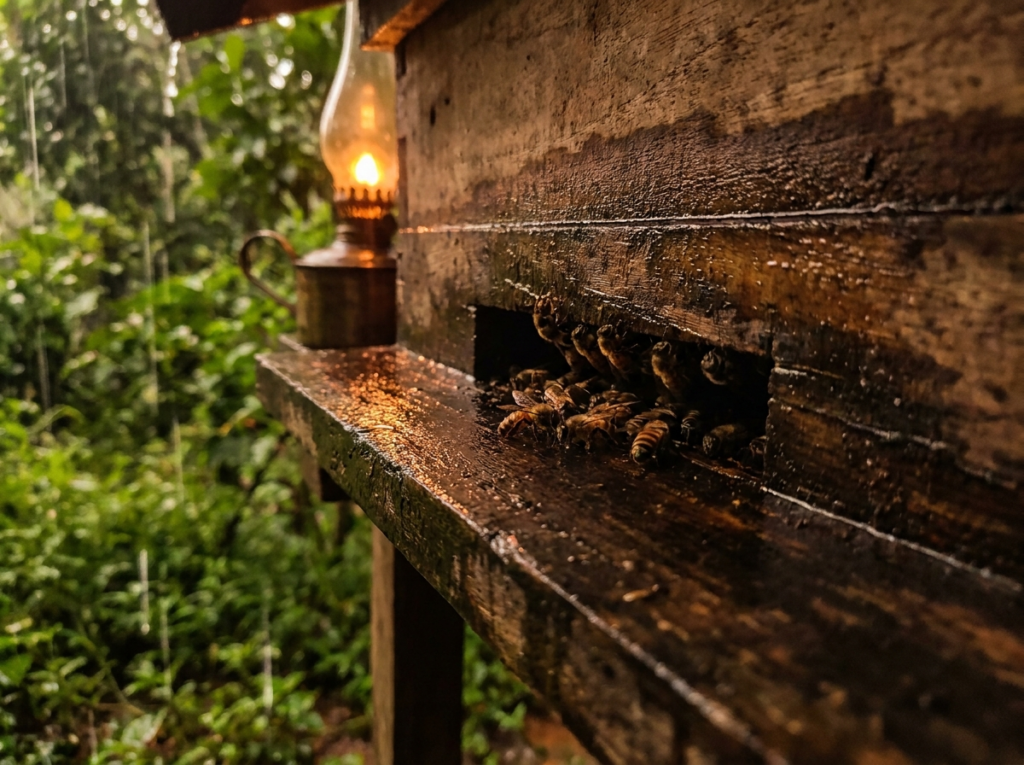
Here in Kerala this is the question that matters, because our bees live with three months of falling water. Bees feel a storm before we do — the drop in pressure, the dimming light — and the hive pulls its workers in like a harbour recalling boats. Heavy rain is dangerous for a creature that weighs a tenth of a gram: a single drop can knock a bee out of the air. So when the monsoon settles in, the colony simply stops flying and lives on what it stored — which is exactly why bees hoard honey in the first place. Inside, the work goes on: cleaning, feeding brood, building, guarding the doorway. A long rainy spell is not a holiday; it is a siege, patiently endured on a full pantry.
A forager caught out when the rain begins does what you would do: she shelters. Under a leaf, inside a deep flower, under the lip of a wall — gripping tight and waiting, sometimes for hours, until the sky lifts enough to fly home.
Why it matters to us
A well-rested colony is an accurate colony — sharp dances, straight flights, honest work. It is one more reason we keep our hives where the bees choose to be: in shade, out of the wind, dry through the rains, and left in peace at night. The bees sleep. The honey is what they were doing all day.