
Tucked into the shaded corners of Kerala homesteads lives a bee most people have never looked at properly: the cherutheneecha, our Indian stingless bee. Barely bigger than a mosquito, entirely without a sting, and quietly responsible for the rarest honey in the state. We wrote about what cheruthen honey is earlier — this is the companion guide: the bee itself, the flowers it loves, and how a Kerala home can keep a colony of its own.
The bee and where it lives
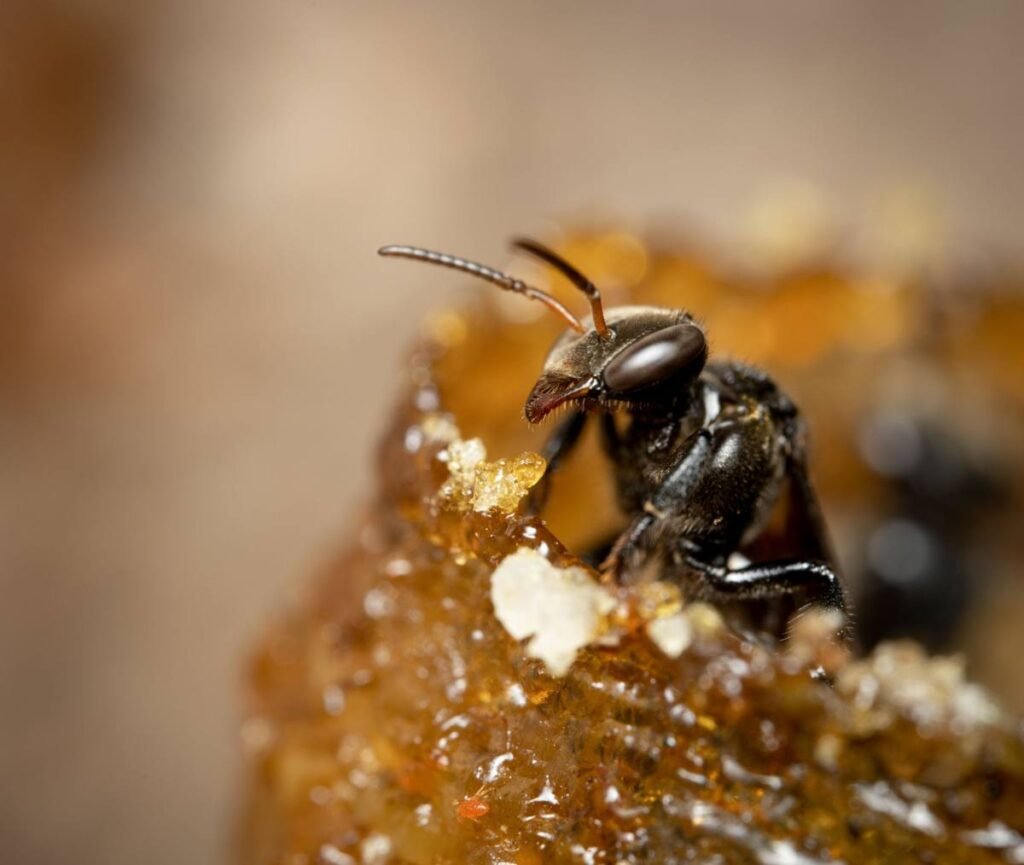
Kerala’s cherutheneecha is Tetragonula iridipennis — jet black, three to five millimetres long, with wings that flash a faint metallic shimmer in sunlight (that is what iridipennis means). In the wild it nests in dark, sheltered cavities: mango, jack and coconut trunks, gaps in old brick and stone walls, hollow bamboo, empty mud pots — even abandoned junction boxes. Wherever it settles, it builds the same way: not open hexagonal comb, but clusters of little resin pots, raised on pillars of dark cerumen like treasure on stands.
What they forage
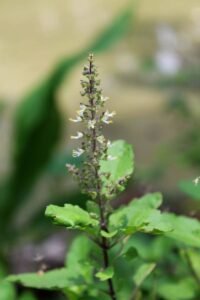
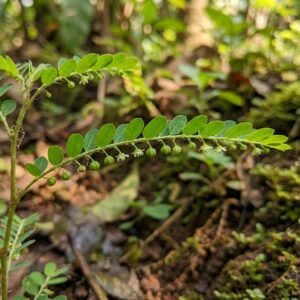
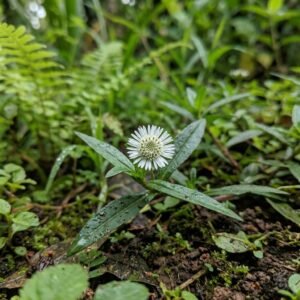
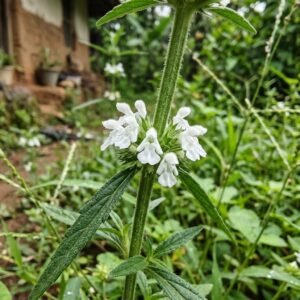
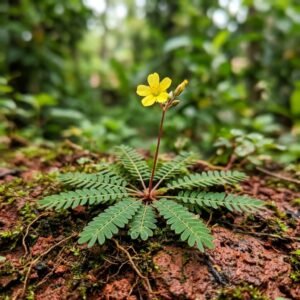
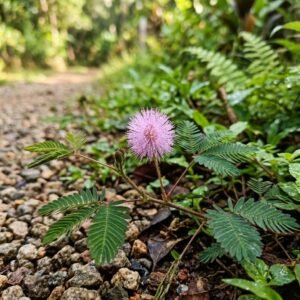
A stingless bee’s tongue is short, so it prefers small, open, shallow blossoms — the tiny flowers bigger bees ignore. Around our own yard the favourites are easy to name: thumba and mukkutti low to the ground, thulasi and keezharnelli by the kitchen, kayyonni and touch-me-not along the fence, and neem when it flowers. In the garden they work chethi (ixora), hibiscus, coral vine, yellow elder and dombeya almost year-round. And above everything stands the coconut palm — its opened inflorescence is a pollen market that never really closes, joined in season by mango, guava, papaya, pumpkin and chilli blossoms.
Medicinal herbs
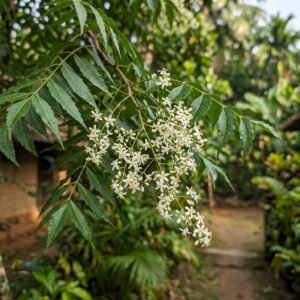
Crops
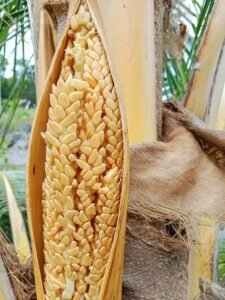
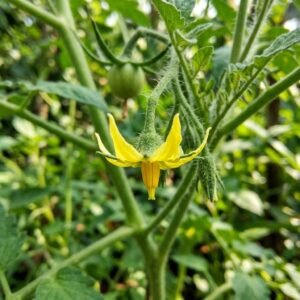
Ornamental
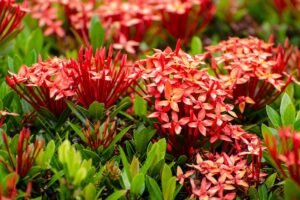
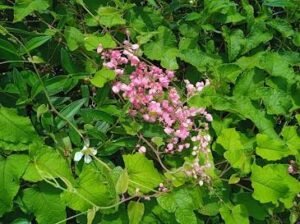
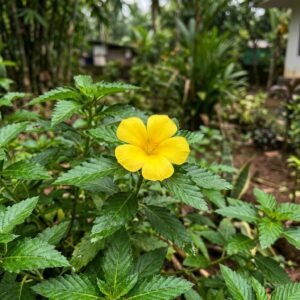
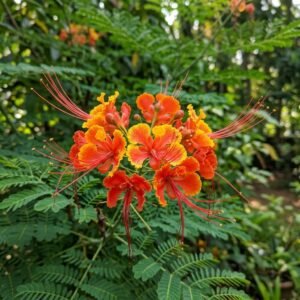
The little bee’s year, flower by flower. More of our own photographs will join as they are taken.
The ‘blue bee’ and the ‘white honey’
Two questions come up again and again. Is there a blue stingless bee? Not quite — the body is jet black, but those iridescent wings can flash blue-purple in strong sun, and the story grows in the telling. And white honey? True white honey exists in a few places in the world where bees work particular blooms, but what people usually see in a Kerala hive is something else: the milky white food that nurse bees place in brood cells, or pale cream pollen packed in its own pots after heavy coconut or guava foraging. Open a hive at the right moment and you would swear it holds three different honeys — gold, cream and white — when really it holds honey, brood food and pollen.
Setting up a hive at home
- The box: teak, jackwood or rubberwood, roughly 30 × 10 × 10 cm. Never plastic or metal — they trap heat and moisture.
- The spot: under a verandah, shed roof or shady canopy, one to one-and-a-half metres off the ground, facing east or southeast so the doorway catches the first sun.
- The moat: grease on the hanging wire or oil cups under the stand legs — ants must never find a dry road in.
The golden rule: the bees build a dark resin tube at the entrance — their guarded doorway, with sentries posted in its mouth. Never break it, never ‘clean’ it. That tube is the colony’s front gate, checkpoint and shield, all in one.
Through the Kerala seasons
In the monsoon, the single rule is dry: no leaks, ever. If rain shuts the bees in for long weeks, a bottle-cap of 1:1 sugar syrup with a floating toothpick (a landing raft) inside the box keeps the colony fed. In high summer, a damp jute sack laid over the box on hot afternoons keeps the wax architecture inside from softening.
Splitting a colony
- Wait for late February to April, when forage is everywhere and the parent hive is packed full.
- Rub a little propolis from the parent hive around the new box’s entrance, so it smells like home.
- Move about half the mature brood discs — the pale yellow-brown ones holding pupae and queen cells — into the new box.
- Add four to six unbroken pollen and honey pots beside the brood. Spill nothing.
- Now the trick: move the parent hive a few metres away and set the new box in the exact original spot — the returning foragers will stock it themselves.
One warning above all: spilled honey during a split is an open invitation to phorid flies and ants. If a pot breaks, wipe it clean that instant.
Uninvited guests
Phorid flies are the number-one enemy — their maggots can turn a storage area into ruin. Keep boxes sealed, wipe spills instantly, and set a small apple-cider-vinegar trap nearby in bad weeks. Ants raid honey and brood — the oil moat is the answer, helped by a sprinkle of turmeric at the stand base. Wax moths, lizards and spiders pick at weak colonies — right-sized boxes, clear space around the entrance tube, and a strong colony solve most of it.
A cherutheneecha colony asks for almost nothing — shade, dryness, small flowers and patience — and gives back a few hundred grams of the most storied honey in Kerala each year. Meet that honey properly here: What is Cheruthen?