

When Kerala thinks of bees, it pictures the loud ones — the honeybees of the hive boxes, the rock bees of the cliffs. But the hardest-working pollinator in a Kerala yard may be one most people have never looked at: the cherutheneecha, our stingless bee, smaller than a grain of rice. We have written about the honey and about keeping a colony — this article is about the third reason she matters, and in the long run the biggest one: what she does for everything that flowers.
Why the smallest bee is a giant pollinator
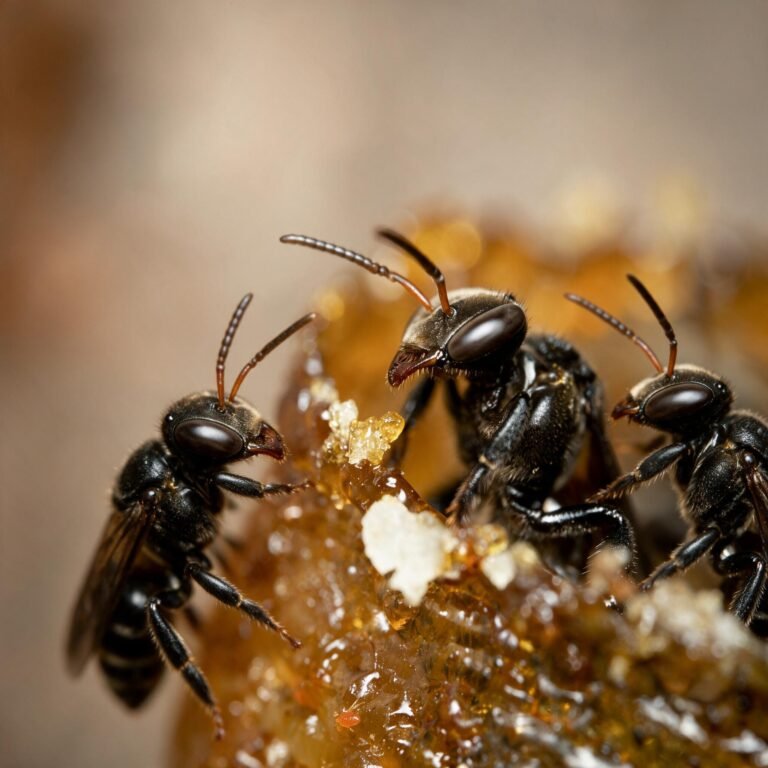
She fits where nobody else can
Big bees skip small doors. The tiny, tubular and tightly-closed blossoms that a honeybee cannot enter — thumba, mukkutti, the little herb flowers of a kitchen garden — are exactly the ones a cherutheneecha slips into without effort. She unlocks the pollination of plants that everything larger flies straight past.
She stays close, and she stays loyal
A stingless bee forages within roughly 100 to 500 metres of her nest — a fraction of a honeybee’s range. That short radius is a gift: the colony pollinates your garden, intensively, all day, rather than scattering its work across the whole panchayat. And she is a creature of habit, returning to the same plants bloom after bloom — the flower-to-flower loyalty that good fruit-set depends on. Indian field studies keep finding the same result: put a stingless-bee box beside cucumbers, pumpkins or vegetable beds and the fruit-set climbs.
The resin round
Nectar and pollen are only two-thirds of her shopping list. Cherutheneecha also gather resins and gums from tree bark — tamarind, teak, mango, jack, neem — to build the dark propolis architecture of the nest. That constant traffic between trees makes the colony part of the orchard’s life, not just a visitor to its flowers.
What to plant — three shelves of flowers
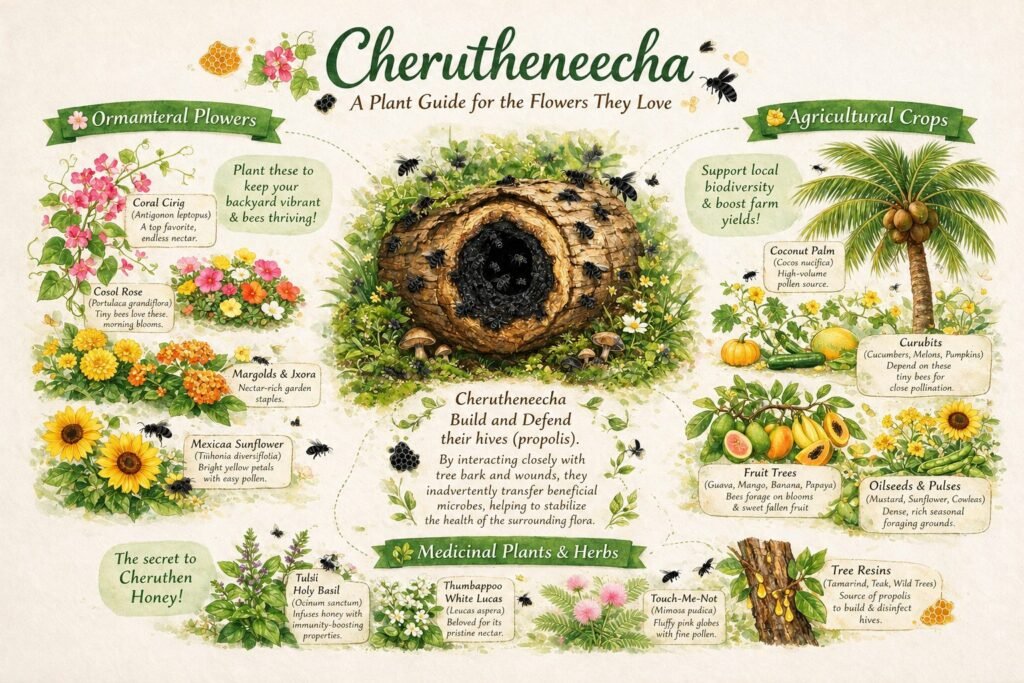
She prefers small, open, shallow blossoms — the full list of her favourites is in the keeping guide. For planting purposes they sort into three shelves:
The ornamental shelf — coral vine, the great bee magnet, whose pink cascades hardly ever stop; chethi (ixora) and marigold, the hardy staples; yellow elder with its open yellow trumpets; and moss rose (portulaca) low to the ground for the morning shift.
The crop shelf — the coconut palm above everything, a pollen market that never closes; the cucurbit family (cucumber, pumpkin, melon), which repays close-contact pollination more than almost any crop; the fruit trees — guava, mango, banana, papaya; and seasonal oilseeds and pulses like mustard, sunflower and cowpea.
The herb shelf — tulsi by the kitchen, thumba along the path, touch-me-not with its pink pollen globes at the fence. These are the plants Kerala has always kept close to the house, and the bees visit them daily — what she visits is what the honey becomes.
The garden, drawn as three circles
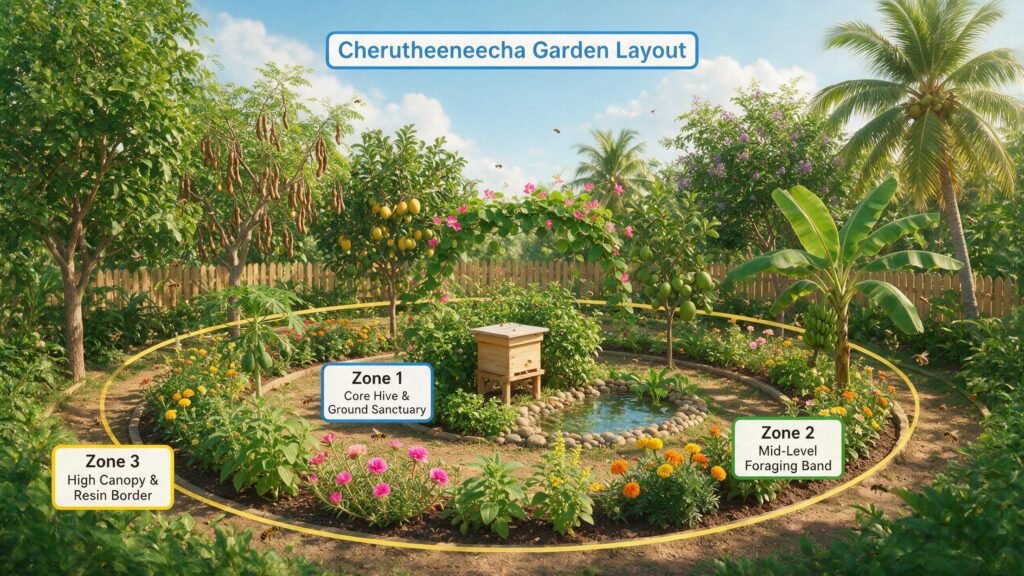
Because her range is short, a cheru garden is designed in rings around the hive — nearest flowers for the youngest fliers, tall trees at the edge for wind and resin.
Zone 1 — the doorstep
The hive box itself is covered properly in the keeping guide — in one line: waist height or a little above, doorway to the morning sun, ants kept off with an oil moat. Two additions belong here. First, a watering station: stingless bees drown easily, so set a shallow clay dish filled with pebbles and water beside the stand — they land on the wet stones to drink. Second, a ground carpet of moss rose and marigold right around the stand, so the youngest and weakest fliers find food at the door.
Zone 2 — the foraging band
Plant in clumps, not sprinkles — patches of a single species at least a metre square, easy to spot from the air and cheap to work. Run a continuous-bloom wall along a fence or trellis: coral vine climbing, thumba and chethi below, layered so that as one finishes flowering the next takes over and no month goes hungry. And put the vegetable and soft-fruit beds here, in the middle of the traffic — the pollination is the point.
Zone 3 — the border
The tall trees at the property edge do two quiet jobs: they break the wind for a bee light enough to be blown off course, and their bark and sap supply the resin she turns into propolis — the material of every pot, pillar and doorway inside the nest. A border of teak, tamarind and neem is hive infrastructure as much as it is shade.
A hive in every home
Here is the thought we keep returning to. A cherutheneecha colony has no sting, fits on a veranda wall, asks only for shade, dryness and small flowers — and in return pollinates every vegetable bed, fruit tree and flowering fence within sight of its doorway. There is no reason every Kerala home with a yard could not keep one. The garden can start before the bees do: plant the three shelves now, and the colony that eventually moves in will find the table already laid. When our shop opens we will have colonies and boxes for families who want to begin — and until then, if you find a wild colony in a wall or a felled tree, do not disturb it. Call a beekeeper; a colony is a gift.